
African countries make progress in disease control, surveillance and routine immunization
Abuja, 3 December 2002 -- Countries in the World Health Organization (WHO) Africa Region made reasonable progress in the areas of accelerated disease control, disease surveillance and routine immunization during 2002, the Regional Adviser for Vaccine Preventable Diseases at the WHO Regional Office for Africa, Dr Deo Nshimirimana has reported.
Nigerian President urges full child immunization across Africa
Abuja, 2 December -- President Olusegun Obasanjo of Nigeria has stressed the need for African countries to focus their collective attention on the task of implementing full immunization of children throughout the Region as a step towards achieving the global goal of polio eradication.
President Kufuour launches Ghana Macrroeconomics and Health Intitiative (GMHI) in Accra
20 November 2002 - His Excellency John Agyekum Kufuor, President of the Republic of Ghana has urged Ghanaian citizens to exhibit a high sense of responsibility in ensuring environmental cleanliness which is a perquisite to good health.
He said Ghana does not need a World Bank loan or grant to stop the indiscriminate use and disposal of waste, particularly plastic which chock gutters and cause stagnant waters that provide breeding grounds for mosquitoes.
China, Africa to cooperate in Traditional Medicine development
China and a number of African countries have adopted a plan of action for co-operation and development of traditional medicine, the WHO Regional Director for Africa, Dr Ebrahim M. Samba, has announced.
Dr Samba told reporters in Brazzaville, Congo, that the cooperation plan was adopted at the first China-Africa Forum on Traditional Medicine convened from 20-22 October in Beijing. Twenty-one African Health Ministers (or their representatives) and a high-level WHO delegation led by Dr Samba participated in the Forum, the final report of which was released Thursday.
Regional Reproductive Health Task Force meeting ends, adopts recommendations
Nairobi, 25 October --The first meeting of the Regional Reproductive Health Task Force -- an expert group set up by the WHO Regional Office for Africa (AFRO) to advise it on Reproductive Health issues -- has ended In Nairobi, Kenya, with the adoption of recommendations aimed at improving access to information, services and commodities designed to promote Reproductive Health in the African Region.
Poor maternal health care to cost Africa $45 billion over ten years
Nairobi, 25 October -- Member States of the World Health Organization (WHO) in the African Region stand to lose $45 billion over a ten-year period (2001-2010) if action is not taken to improve maternal health care in the Region, according to statistics released Friday in Nairobi by WHO.
WHO urges comprehensive, coordinated approaches to Reproductive Health issues
Nairobi, 22 October --- African governments and other stakeholders with an interest in Reproductive Health have been urged to go beyond piecemeal activities and embrace comprehensive and coordinated approaches, in collaboration with partners, while addressing Reproductive Health concerns in the Region.
Kenya commends WHO for facing up to Reproductive Health challenges
Nairobi, 22 October -- Kenya's Public Health Minister, Prof. Sam Ongeri, has commended the World Health Organization for responding to the Reproductive Health challenges facing the African Region by establishing an expert body to advise on how to address the problems.
Exhibition on Poverty and Health in Africa Opens at UN Headquarters on 16 September as Part of NEPAD Day
New York -- The World Health Organization and the United Nations Department of Public Information are organizing an exhibition on Poverty and Health: Challenges to Development in Africa at the UN headquarters in New York City on Monday, 16 September. This exhibition will be launched under the patronage of the Heads of State who initiated the New Partnership for Africa's Development (NEPAD) and the UN Deputy Secretary General Louise Frechette.
Cholera in Sierra Leone: the case study of an outbreak
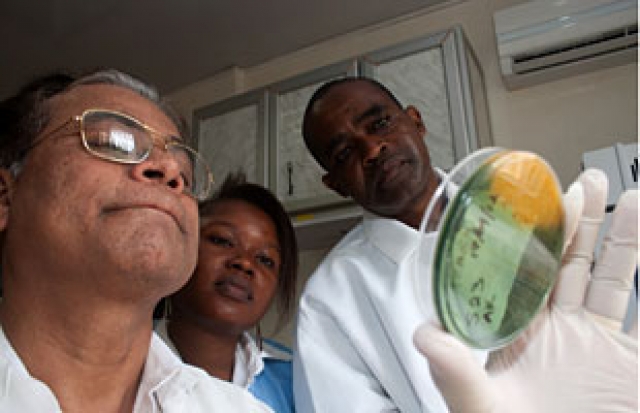
Sierra Leone is in the midst of its worst cholera outbreak in 15 years. As of 19 September, there were more than 19 000 cases reported and 274 deaths. WHO and the Ministry of Health and Sanitation have established a cholera control and command centre to coordinate the response to what has turned into a national emergency.