Sota, Democratic Republic of the Congo — Behind a small wooden window in a newly-erected isolation room, a suspected Ebola patient kept looking out, hoping to see a family member.
Outside, orange mesh tape marked the boundary between safety and risk. A few metres away, patients had gathered for routine care at the Sota health facility. Health workers carried medication towards another makeshift structure where confirmed Ebola patients were receiving treatment. Nearby, the sound of hammers echoed across the compound as a logistics team worked to set up a tent that will serve as a two-bed intensive care unit for critically ill patients.
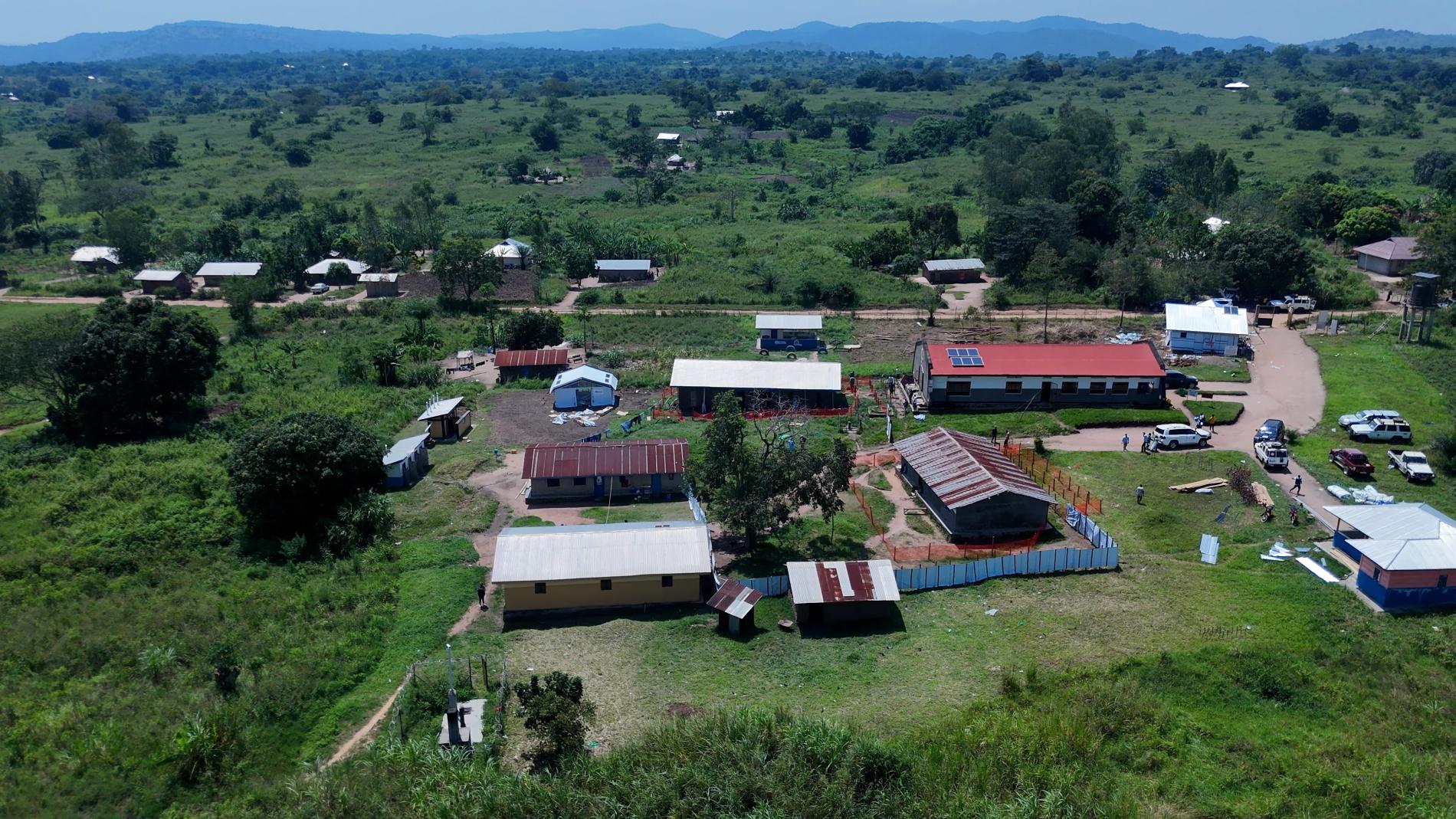
This is what Ebola response looks like in Sota: not in a fully equipped specialist hospital, but in a modest rural health facility being rapidly transformed while it continues to serve a community already facing insecurity, limited resources and fear.
Sota lies about 50 kilometres from Bunia, in Ituri province in eastern Democratic Republic of the Congo. The journey from Bunia begins early on a Sunday morning, with a security briefing at a meeting point. Blue armoured vests and helmets are handed out for protection should the need arise. The convoy then sets off, led by security detail.
Within minutes, the tarmac gives way to winding, dusty roads. Children wave as the vehicles pass. The road is difficult, but it also tells part of the story: in places like Sota, distance, insecurity and weak infrastructure can determine how quickly patients are reached, how safely health workers can move, and how effectively an outbreak can be contained.
For the WHO teams supporting the response, the journey between Bunia, Nyakunde and Sota has become routine. But routine does not mean easy. The communities around Sota continue to live under the shadow of armed violence. A road that is calm one day may become inaccessible the next. Every movement must be planned carefully.
After nearly two hours, the team arrives at the health facility.
The main building is modest, with a few patients waiting outside. Behind it stand two mud-built structures. One, on the left, has been cordoned off with orange mesh tape. The zoning is clear: green for areas considered safer, red for areas where the risk of infection is higher. Inside, suspected Ebola patients receive care while waiting for their test results.
The second structure, on the right, is where confirmed Ebola patients are being treated. Health workers move carefully between the spaces, balancing urgent clinical care with the strict infection prevention measures required to protect themselves, other patients and the wider community.
Dr Moïse Asim, the Medical Director at Sota medical centre, says the facility was not built for an emergency of this kind. “At the beginning of the outbreak, we faced significant challenges in organizing patient care. We did not have dedicated spaces to separate suspected and confirmed cases from patients with other illnesses,” he says.
That challenge goes to the heart of the Ebola response in rural areas. Communities may do the right thing by seeking care, but the first place they reach is often a small health centre with limited staff, unreliable electricity and few resources. In an Ebola outbreak, that can place patients, health workers and other families at risk unless the facility is quickly supported to separate cases, strengthen infection prevention and maintain essential services.
In Sota, that work is now under way.
Across the compound, World Health Organisation (WHO) logistics staff are setting up a tent to serve as a two-bed intensive care unit for patients who become critically ill. The team is also upgrading sanitation facilities to ensure that toilets used by confirmed Ebola patients are not shared with other patients.
“We identified this as an urgent need for the patients and community. We are also upgrading the toilets to ensure those used by confirmed cases will not be used by other patients,” says Alex Freeman, Health logistics officer at WHO AFRO.
The health facility operates under difficult conditions, grappling with unreliable electricity, a shortage of healthcare workers, and limited resources that stretch an already fragile system.
“What we are seeing in Sota illustrates why decentralizing the response is so important. As we expand services closer to communities, we are reaching health facilities that have already managed cases but were not adequately prepared. Communities did the right thing by seeking care, and our role is to ensure that frontline health facilities have the capacity, equipment and support they need to respond safely and effectively.”
In a disease where every delay can allow the virus to spread further, community engagement becomes a core part of the emergency response.
“There was reluctance within the community to engage with the response. Over time, however, sustained awareness campaigns have helped build trust and improve acceptance. Working through community health volunteers, we continue to conduct outreach in villages and households, encouraging people to report suspected cases and anyone identified as contact,” says Asim, who is supporting the response.
Inside the facility, the patient at the wooden window continues to wait. The image is quiet but powerful: a person separated from family for safety, a health worker moving carefully through risk zones, a rural clinic trying to adapt faster than the virus can spread.
In Sota, the Ebola response is not only about containing an outbreak. It is about helping a small clinic become safer, stronger and better prepared for the next emergency and for the everyday health needs that continue long after the outbreak ends.
The WHO team will continue working with the health facility in facilities like Sota to strengthen community engagement, enhance disease surveillance, and reinforce infection prevention and control (IPC) practices. Together, these efforts are helping to build a health system that is better prepared, not only for the next Ebola outbreak, but for the everyday health needs of the communities it serves.