Two of a kind - Rotarians united against polio
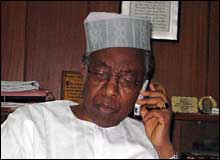
6 April 2005 -- They are both over 70 years of age, but for Adedehin Ebunolu Adefeso, past District Governor (PDG) of District 9110 (1995-1996), and Jonathan Majiyagbe, former President of Rotary International(2003-2004), polio eradication is such a strong unifying force for the club and they have devoted their lives to promoting its ideals.
Silent emergency of motherhood in africa: Dr Sambo urges paradigm shift in the way care is provided
Brazzaville, 6 April 2005 -- Health is a fundamental human right. Yet, to a large number of women, newborns and children in Africa, this right is denied. Every 60 minutes, 130 newborns die in the African Region. In the same lapse of time, 60 women die of causes relating to pregnancy and childbirth.
WHO Regional Director kicks off second round of polio campaigns in Zamfara state
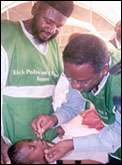
6 April 2005 -- Enthusiasm and commitment for polio eradication was high at the flag-off of the second round of National Immunization Days at Talata Marafa local government area in Zamfara State. World Health Organization (WHO) Regional Director for Africa, Dr. Luis Gomes Sambo, joined Professor E. Lambo, Federal Minister of Health and His Excellency the Executive Governor of Zamfara State Alhaji Ahmed Sani Yariman Bakura to launch the final push to stop polio for good in Zamfara state.
Sambo appeals for more funding for health
Abuja, 5 April 2005-- The developed countries of the world and Member States of the World Health Organization (WHO) have been called upon to provide more resources for health, especially to African countries, so as to enable Africa achieve the health Millennium Development Goals (MDGs). The WHO Regional Director for Africa, Dr. Luis Gomes Sambo made the appeal in Abuja, Nigeria, at a joint Ministerial media briefing to mark this year's World Health Day in the country.
WHO to pursue decentralization of operations in Africa
Brazzaville, 10 March 2005 -- Operations of the World Health Organization (WHO) in the African Region are being rapidly decentralized “so that focus will be on country level activities” WHO Regional Director for Africa, Dr Luis Sambo, has said.
WHO, UNICEF, discuss collaboration in Africa
Brazzaville, 7 march 2005 -- The Directors of the WHO Regional Office for Africa and the UNICEF Office for West and Central Africa open discussions Tuesday in Brazzaville, Republic of Congo, on ways to collaborate in achieving a common goal - improving the health status of people in the African region.
WHO pledges accelerated action to reduce Africa's disease burden
Brazzaville, 28 February 2005 - The World Health Organization (WHO) has pledged accelerated action to help reduce the disease burden in Africa and to assist countries in the region to achieve the Millennium Development Goals (MDGs).
The pledge was made Thursday in Brazzaville by the WHO Regional Director for Africa, Dr Luis Sambo, while handing over medicines, medical equipment and vehicles worth more than US$290,000 to the Congolese government.
22-Nation Synchronized Immunization Campaign To Reach 100 Million Children as Virus Spreads to Ethiopia
DAKAR/HARARE/GENEVA/EVANSTON, 25 February 2005 – A mass polio immunization drive starting today across Africa gained greater urgency from reports that a child has contracted polio in Ethiopia, the first case there in four years.
First forum to address oral health opens in Rwanda
Kigali, 17 February 2005 -- The Health Minister of Rwanda, Dr Jean Damascène Ntawukuliryayo, today opened the first ever high-level forum on oral health in the country.
Opening a workshop on oral health Thursday in Kigali, Dr Ntawukuliryayo said: "In elaborating our strategic plan for the next five years, my ministry gives a high priority to the management of non-communicable diseases, including oral health. In fact, in Rwanda oral health is a public health concern according to oral health needs expressed by the population".
Dr Ebrahim Samba hands over to Dr Luis Sambo
Brazzaville, 31 January 2005 -- Outgoing WHO Regional Director for Africa, Dr Ebrahim Samba, handed over to his successor, Dr Luis Sambo at the weekend, and proceeded to his native Gambia on retirement.
In a tribute to Dr Samba, Dr Sambo said, "I would like to recognize and thank you immensely for the work you have done in the WHO Regional Office and for the African Region as you pushed the frontiers of health for all Africans everywhere. You are leaving behind many tangible and measurable achievements."