Zambia Hosts WHO Project Meeting on Strengthening Cervical Cancer Prevention Programmes in Six African Countries
21 October 2009 -- The final review meeting for the six African countries implementing the WHO demonstration project on strengthening cervical cancer prevention programmes opened in Lusaka on 20th October, 2009. This meeting has brought together more than forty participants from the participating countries which include Madagascar, Malawi, Nigeria, Tanzania, Uganda and Zambia.
Better data for better health in Sierra Leone
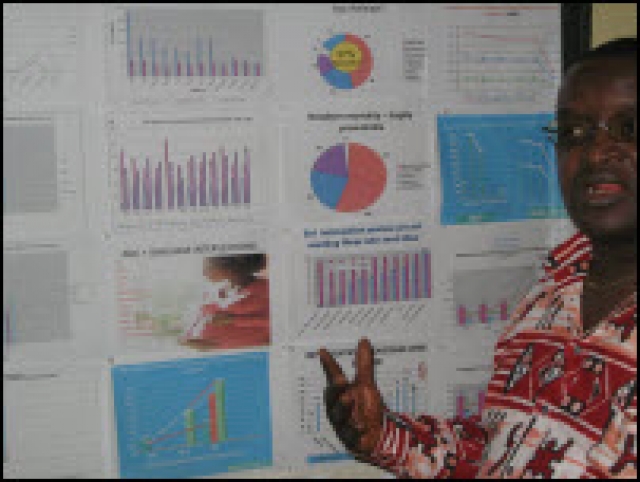
Sierra Leone's district health information system (DHIS) captures data from hundreds of community health centres across the country. The system, developed with the support of the Health Metrics Network, is designed to bring information together to permit analysis and comparison of results. Collected at village and community levels, data are being compiled and analysed at the district level in the computer-based DHIS before being transmitted to the Ministry of Health and Sanitation in the capital, Freetown
Press Release on the Handover Ceremony of a Donation to the Office of the Lusaka District Commissioner
Lusaka, 05 October 2009 -- The World Health Organization Country Office for Zambia donated a computer, printer and a UPS to the office of the Lusaka District Commissioner today as a way of building capacity in that office in terms of epidemic prevention and control. The Lusaka District Commissioner’s office is spearheading this campaign under the Disaster Risk Reduction (DRR) Programme.
WHO gives bicycles, motorcycles, medicines to Zimbabwean health authorities
Harare, 30 September 2009 -- The World Health Organization officially presented hundreds of bicycles and motorcycles to the Zimbabwean Ministry of Health here today to strengthen health care and disease surveillance activities throughout the country.
The 300 black bicycles and 124 bright red motor cycles were purchased with US$ 500 000 acquired by WHO via the UN's Central Emergency Response Fund. These items strengthen Zimbabwe's ability to prepare for and respond to potential health concerns, including cholera outbreaks and the pandemic H1N1 2009.
Landmark H1N1 response plan launched in Zimbabwe
Harare, 30 September, 2009 -- A landmark plan to improve how countries, particularly developing nations, can better protect themselves against the pandemic H1N1 2009 has been applied for the first time in the world during a two-day workshop in Zimbabwe that ended today.
Africa Malaria Day campaign -2006: Zimbabwe
Theme Get your Act together - Slogan Universal Access to effective malaria treatment is a human right
Background
Dr Sambo Cautions on Drug Resistance Related to HIV/AIDS, TB, and Malaria; Proposes Actions to Address Threat
Kigali, 1 September 2009 -- WHO Regional Director for Africa, Dr Luis Sambo, has warned of widespread development of drug resistance related to HIV/AIDS, tuberculosis and malaria and proposed concrete measures to address this emerging threat to public health in the Region.
"This issue (of drug resistance) must be addressed before the situation gets out of hand", Dr Sambo told delegates to the 59th session of the WHO Regional Committee for Africa which entered its second day in Kigali on Tuesday.
Fifty-Ninth Session of WHO Regional Committee for Africa ends, Nominates Regional Director, Adopts Resolutions
Kigali, 4 September 2009 -- The fifty-ninth Session of the WHO Regional Committee for Africa ended on Friday in Kigali, Rwanda, after nominating a Regional Director and adopting resolutions aimed at scaling up action in areas that are key to improving the health situation in the Region.
Zimbabwe Launches National Clean Up Campaign
Harare, 03 September 2009 -- The acting President, Cde Joyce Mujuru today officially launched the national clean up campaign at her Munhumutapa offices in Harare. The campaign, which is the brainchild of the Social Mobilization taskforce of the Cholera Command and Control Centre (C4), is part of the many on-going cholera awareness campaigns ahead of the cholera season.
WHO African Region Considers Measles Elimination – Dr Sambo
Kigali, 2 September 2009 -- "The remarkable reduction of measles deaths by an estimated 89% between 2000 and 2007 in the African Region" gives reason to hope that the disease can be eliminated in the WHO African Region by the target year of 2020.
This assessment is contained in a report to be presented Tuesday by the WHO Regional Director for Africa, Dr Luis Sambo, to the 59TH session of the WHO Regional Committee for Africa taking place in Kigali, Rwanda.