
Brazzaville to host Meeting on Task Force on Immunization
Brazzaville, 28 February 2006 -- The 13th meeting of the Task Force on Immunization (TFI) in Africa and the 12th meeting of the African Regional Inter-Agency Coordination Committee (ARICC) will take place from 28 February to 3 March 2006, in Brazzaville, Republic of Congo.
The TFI and ARICC meetings, held annually since 1993, provide a forum for the review of the regional immunisation activities to control vaccine preventable diseases, which cause nearly one million of childhood deaths in Africa every year.
Health Minister calls on Nigerians not to panic
Abuja, 13 February 2006 -- Nigeria’s Health Minister, Prof. Eyitayo Lambo, has urged Nigerians not to panic and assured that the government was taking measures to ensure that there was no human infection of the bird flu confirmed in poultry in northern Nigeria early this month.
WHO experts arrive Nigeria to help fight bird flu
Abuja, 13 February 2006 -- A team of World Health Organization (WHO) experts led by the Agency’s Director for Africa, Dr Luis Sambo, arrived Nigeria Sunday to support the country’s efforts to contain an outbreak of the highly pathogenic avian influenza which was first reported in Nigeria on 6 February.
WHO International Experts in Angola to Support the Elaboration of the National Health Policy
National Health Policy Would focus on the sustainable development of the health sector
Luanda, 9 February 2006 -- A team of international experts from the World Health Organization (WHO) is currently in Angola for a ten-day mission aimed at supporting the country in the process of elaboration of its National Health Policy. A special request in this regard has been made by the Ministry of Health which is willing to finalize a National Health Policy in the next two months, with the technical support of WHO.
Avian influenza in Africa: statement by the Director-General of WHO
9 February 2006-- The confirmation of H5N1 avian influenza in poultry in Africa is a cause for great concern and demands immediate action. This is the first reported incidence of this highly pathogenic virus on the continent, where people are already enduring the HIV/AIDS pandemic and other serious infectious diseases. The H5N1 virus now confirmed in Nigeria poses a risk to human health and livelihood.
Avian influenza confirmed in birds in Nigeria
Avian influenza - situation (birds) in Nigeria
8 February 2006
The confirmation of highly pathogenic H5N1 avian influenza in domestic birds in northern Nigeria marks the further geographical spread of this virus. Although all evidence to date indicates that the virus does not spread easily from birds to humans, careful monitoring of the situation is warranted.
Reaching them wherever they are - The boosting childhood immunity approach
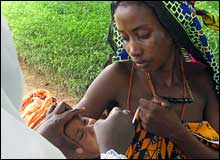
27 January 2006 -- Abdullahi Wamzan, a community leader, watched with satisfaction as Attahiru Mohammed Chidawa, a trained health worker, vaccinated the children of Unguwan Magaji Lagan, a Kamberi Settlement in the Magama local government area (LGA) of Niger State. It was the first time ever that the community was hosting such an exercise to boost immunity in hard to reach areas among people who may not otherwise access immunization and other health services.
Africa: working for health in Mbandaka, Democratic Republic of the Congo
Located 730 km north-east of Kinshasa, Mbandaka is the capital of Equateur Province. Over 200 000 people live in Mbandaka. There is no electricity and no piped water. There are also no taxis, buses, trains or ambulances in the town. Transport to and from Kinshasa is either by one of the six weekly flights to the small airport, or by boat on the Congo river – a journey taking around one week each way.
Regional Director for WHO African Region urged to Member States in the Region to urgently ensure that their national plans include laboratory components for both human and animal aspects.
Regional Director for WHO African Region urged to Member States in the Region to urgently ensure that their national plans include laboratory components for both human and animal aspects.
Regional Meeting on Preparedness and Response to Pandemic Influenza in Brazzaville
Brazzaville, 12 January 2006 --The first conference on preparedness and response to pandemic influenza in the African Region has been inaugurated by the Regional Director for WHO African Region, Dr Luis Gomes Sambo, in the presence of the gathering of outstanding specialists, development partners and representatives of Member States from veterinary and public health sectors.