2 Million People Successfully Vaccinated in Abidjan Following an Urban Yellow Fever Outbreak
Abidjan/Brazzaville, 8 September 2008 -- The city of Abidjan, Cote d'Ivoire can once again be considered safe from a Yellow Fever epidemic after the national Ministry of Health, the World Health Organization (WHO), UNICEF nongovernmental organizations and others in the Yellow Fever Partnership combined their forces to vaccinate over 2.2 million people in the Ivorian capital.
Dr Sambo calls for robust monitoring and evaluation mechanisms to track progress on health
Yaoundé, 5 September 2008 -- The 58th Session of the World Health Organization Regional Committee for Africa ended in Yaoundé, Cameroon on Friday 5th September 08.
The Committee deliberated on a range of issues such as women’s health, cancer prevention and control, harmful use of alcohol, strengthening public health laboratories, iodine deficiency, patient safety, oral health strategy, programme budget, amendment of the Medium Term Strategic Plan, the Ouagadougou and Algiers declarations.
WHO Regional Director addresses academics on Primary Health care
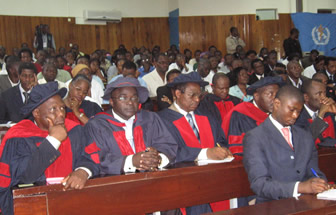
Yaoundé, 4 September 2008 -- The WHO Regional Director for Africa Dr Luis Gomes Sambo has called for the need to strengthen health systems based on the Primary health Care (PHC) approach.
Speaking at a gathering of academics and students from the Faculty of Medicine of the University of Yaoundé One, Cameroon, Dr Sambo highlighted the key principles of primary health care and mentioned some of the factors that slowed down its implementation in the African region.
African countries to introduce new meningitis vaccine
4 September 2008 | YAOUNDE -- Health ministers from countries of the African meningitis belt today committed themselves to introduce a highly promising candidate meningitis vaccine. The vaccine is designed to prevent periodic epidemics of the deadly disease in these countries.
Meeting at the 58th session of the WHO Regional Committee for Africa, held in Yaoundé from 1 to 5 September, the ministers adopted the Yaoundé Declaration, committing themselves to several actions.
Africa Makes Modest But Steady Progress in HIV Prevention
Yaoundé, 2 September 2008 -- African countries have made modest but steady progress in curbing HIV infection since the WHO Regional Office for Africa spearheaded the launch, in 2006, of an initiative to accelerate HIV prevention in the Region.
This assessment is contained in a progress report presented by the WHO Regional Director for Africa, Dr Luis Sambo, to the fifty-eighth session of the Regional Committee for Africa taking place in Yaoundé, Cameroon.
Implementing the Oral Health Strategy in the African Region
Yaoundé, 2 September 2008 - A decade ago, governments in the WHO African Region adopted a strategy to improve the oral health (ORH) of their people; but, ten years on, significant challenges still hamper its progress.
The five pillars of the 1998 ORH strategy are: development and implementation of national strategies; integration of oral health into national health programmes; service delivery; use of a regional education and training approach for oral health programmes; and the development of an oral health management and information system.
WHO Proposes Strategy for Prevention and Control of Cancer in the African Region
Yaoundé, 2 September 2008 -- The World Health Organization (WHO) has proposed a strategy to prevent and control cancer, 582 000 cases of which were recorded in the Region in 2002.
Cancer of the cervix, breast, liver and prostate as well as Kaposi’s sarcoma and non-Hodgkin’s lymphoma are the most common forms of cancer in the African Region. Incidence of these cancers are projected to double by 2020 if effective interventions are not intensified.
What Africa Should do to Improve Patient Safety – Dr Sambo
Yaoundé, 2 September 2008 -- World Health Organization (WHO) Regional Director for Africa, Dr Luis Sambo, has called on African countries to prioritize “patient safety”, a concept that refers to processes or structures which, when applied, reduce the possibility of adverse events resulting from exposure to the health-care system across a range of diseases and procedures.
Governments Challenged To Improve the Health of Women in the African Region
Yaoundé, 2 September 2008 -- “By virtue of their multiple roles, women constitute a key link in the chain of development, and efforts must be made by African countries to ensure that women are in a state of physical, mental and social well-being to be able to carry out their numerous responsibilities.”
This call for action was made on Tuesday in Yaoundé by the WHO Regional Director for Africa, Dr Luis Sambo, in a report to the fifty-eighth session of the WHO Regional Committee to Africa taking place in the Cameroonian capital.
WHO Urges Action to Kick Polio Out of Nigeria
Yaoundé, 2 September 2008 -- There is an urgent need to interrupt wild poliovirus in Northern Nigeria, sustain optimum involvement of communities in high-risk areas, and conduct independent monitoring and evaluation of immunization activities at all levels.
This key recommendation is contained in a report to be discussed today at the fifty-eighth session of the WHO Regional Committee for Africa taking place in Yaounde, Cameroon.