Implications of the global financial crisis for the health sector in Africa
Malabo (Equatorial Guinea) 1 September 2010 -- “There is a real danger that funding for health development in the African Region might be adversely affected by the ongoing global financial crisis and thereby compromise any ongoing national and international efforts in many countries to realize the Millennium Development Goals”.
This assessment is contained in a report by WHO Regional Director for Africa, Dr Luis Sambo, to the 60th session of the WHO Regional Committee for Africa taking place in Malabo, Equatorial Guinea.
WHO proposes strategy to reduce harmful use of alcohol
Malabo, 31 August 2010 -- The World Health Organization has proposed a strategy to prevent or at least reduce the harmful use of alcohol and related problems in the African Region.
WHO Regional Committee Meeting Opens in Malabo
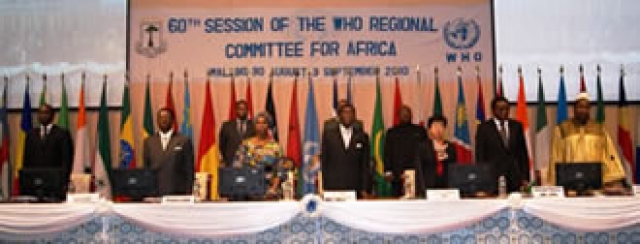
Malabo 31 August 2010 -- The sixtieth session of the World Health Organization Regional Committee for Africa World Health Organization opened in Malabo on Monday with a call by President Obiang Nguema Mbasogo of Equatorial Guinea to Member States to prioritize maternal health because “ women are the back bone of the family in Africa.”
Sierra Leone Commemorated African Traditional Medicine Day
The Sierra Leone Traditional Healers Association with support from WHO and Concern Worldwide has commemorated the 10th African Traditional Medicine Day on the theme “A decade of Traditional Medicine: Progress so far” in Makeni, on 31st August 2010. The occasion was attended by traditional healers and medical practioners and partners.
Dr Alhaji B.M.S Turay, chairman of traditional Healers Association, gave the keynote address on the theme “Traditional African Medicine in Sierra Leone-The useful neglected partner”.
Improving routine immunization services and achieving polio eradication in the African Region
Malabo (Equatorial Guinea) 30 August 2010 -- Significant progress has been made in immunization coverage and efforts to eradicate polio in the African Region, but challenges remain and immediate remedial actions need to be taken.
This assessment of the status of routine immunization and polio eradication efforts in the African Region is contained in a technical document being discussed today by the 60th Session of the WHO Regional Committee for Africa taking place from 30 August to 3 September in Malabo, Equatorial Guinea.
Africa urged to embrace and use e-Health
Malabo (Equatorial Guinea), 30 August 2010 -- African countries have been urged to embrace and use e-Health -- defined by the World Health Organization (WHO) as the cost-effective and secure use of information and communication technologies (ICT) for health and health–related fields - with a view to contributing to strengthening their health systems and improving health outcomes.
Equatorial Guinea to Host WHO Regional Committee for Africa
Brazzaville/Malabo, 27 August 2010 -- The sixtieth session of the World Health Organization (WHO) Regional Committee for Africa will take place from 30 August to 3 September in Malabo, Equatorial Guinea.
Ethiopia Holds Consultative Meeting on the WHO Global Health Sector Strategy for HIV/AIDS: 2011 - 2015
27 August 2010, Addis Ababa -- The WHO Ethiopia Country Office in collaboration with the Ethiopian Federal Ministry of Health (FMOH) convened a half day consultative meeting to deliberate on the WHO Global Health Sector Strategy for HIV/AIDS: 2011 – 2015.
The meeting brought together a wide section of stakeholders from FMOH, UN Agencies, NGOs, PLWHA Associations, bilateral and multi lateral agencies among others.
WHO donates to the College of Health Sciences Library
Harare, 24 Aug.2010. In a move that is aimed at addressing the 3 pillars of health systems in Zimbabwe; health workforce, leadership and governance, and technologies; WHO donated to the University of Zimbabwe ’ s College of Health Sciences Library,
WHO Supports the development of a National Child Survival Strategy
One of the targets of the Millennium Development Goals is to reduce child mortality by two third between 1990 and 2015. According to the 2008 assessment of countdown to 2015, Eritrea is on track to meet this goal, with consistent progress in reducing child deaths with an average annual reduction of around 4% over the last decade.
Still, infant and under5 mortality rates in Eritrea are considered high in reference to the MDG 4 target, which is 49/1000 Live Births by 2015.