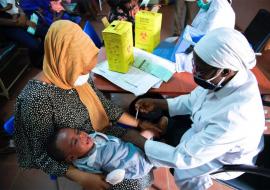
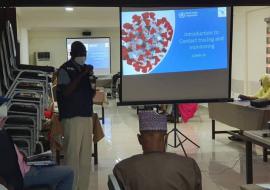
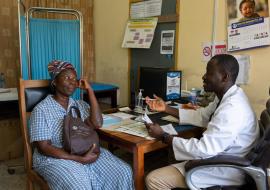
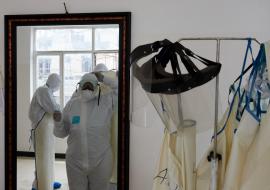
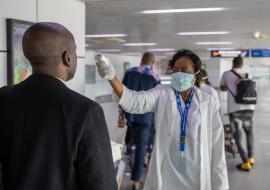
Kano, 13 May 2020 – At the Hasiya Bayero Paediatric Hospital in downtown Kano, the commercial nerve centre of northern Nigeria, Aisha Iliasu sits patiently amon
Ghana has strengthened its medicines regulatory system to ensure safety, quality and effectiveness of medical products manufactured, imported or distributed within the country, the World Health Organization (WHO) announced today.
In an expanded pool of expertise, the World Health Organization (WHO) is supporting several African countries to coordinate the work of external emergency medical teams deployed to support the efforts to contain the spread of COVID-19 pandemic.
Eighty-three thousand to 190 000 people in Africa could die of COVID-19 and 29 million to 44 million could get infected in the first year of the pandemic if containment measures fail, a new study by the World Health Organization (WHO) Regional Office for Africa finds. The research, which is based on prediction modelling, looks at 47 countries in the WHO African Region with a total population of one billion.
From “COVID-19 does not exist”, to COVID is not going to survive in Kano, to COVID is finished as soon as it gets here, Kano state residents got so comfortable and rebuffed Nigeria Center for Disease Control (NCDC) guidelines on COVID-19.
The World Health Organization (WHO) welcomes innovations around the world including repurposing drugs, traditional medicines and developing new therapies in the search for potential treatments for COVID-19.
Thirty-five-year old Salihu Umar was diagnosed with COVID-19 after returning from a six-day trip to London in March 2020. Although asymptomatic, he tested positive and underwent treatment. Having recovered and back with his family in the Nigerian capital Abuja, the father of three stresses the importance of getting tested especially after having travelled to an area affected by the virus.
When COVID-19 emerged as a global health threat, African countries were quick to enact public health measures to slow the spread of the virus. Now as some countries begin to ease lockdowns, it is important to maintain strong surveillance, case finding and testing among other control measures to halt the pandemic.