
Improving multisectoral collaboration for cancer prevention and care in The Gambia
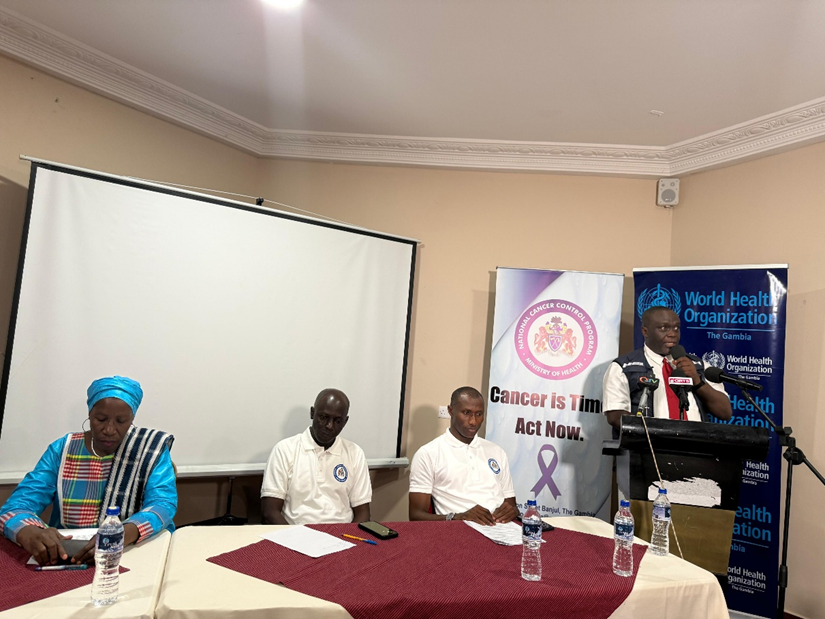
Banjul—On 22 April 2026, the Ministry of Health (MoH) in collaboration with World Health Organization (WHO) in the Gambia convened Civil Society Organizations (CSOs) and national stakeholders in Banjul to reinforce collaboration under the National Cancer Control Plan (NCCP). The meeting brought together key stakeholders to reinforce a shared commitment to a more integrated national response to cancer, spanning prevention, early detection, diagnosis, treatment, palliative care, surveillance, and research.
Opening the engagement, Dr Ifeanyi Udenweze, speaking on behalf of the WHO Representative, underscored that meaningful progress in cancer control can only be achieved through collective effort. He stressed that strong partnerships across all levels of the health system remain central to improving outcomes.
“Cancer control cannot be achieved by one institution or one sector alone. It requires a coordinated system that brings services closer to communities, strengthens trust in the health system, and ensures that people are diagnosed earlier and treated on time. When we work together in a structured and sustained way, we significantly improve survival and reduce preventable deaths,” he said.
Building on this, he further highlighted that sustained collaboration between government, civil society, and development partners is essential for long-term progress in both prevention and care.
From the national side, The Ministry of Health reaffirmed its commitment to building a more integrated and efficient national cancer response. Representing the Director of Health Services, the Trauma and Injury Prevention Program Manager, Mr. Abou Mass emphasized the importance of moving away from fragmented efforts towards a unified national framework.
“The National Cancer Control Plan marks a clear shift in how we respond to cancer in The Gambia. We are moving from isolated interventions to a coordinated national system that integrates prevention, early detection, diagnosis, treatment, palliative care, and surveillance. This allows us to work more efficiently and reduce avoidable deaths through a stronger and better-connected health system,” he said.
In the same spirit of strengthening coordination, the Programme Manager for the National Cancer Control Programme (NCCP), Dr Bojang Kebba, drew attention to the growing burden of cancer in the country and the urgency of collective action. He noted that The Gambia records an estimated 1196 new cancer cases and about 899 deaths annually, with many cases linked to late diagnosis, limited awareness, and barriers to timely care.
He therefore emphasized that civil society remains central to reversing these trends. “Civil society is central to the success of the National Cancer Control Plan. Their role in community awareness, early detection, referral, advocacy, and continuity of care is critical in ensuring that services reach the people who need them most and that no one is left behind,” he said.
He added that too many cases are still detected at advanced stages, which significantly limits treatment options and survival outcomes. This, he noted, makes early screening and community engagement not just important, but essential pillars of the national response.
Reinforcing this perspective, Ms. Ndey Sireng Bakurin, Executive Director of the Association of Non-Governmental Organizations (TANGO), highlighted the critical role of civil society in bridging gaps between communities and health services. She pointed to their influence in raising awareness, reducing stigma, and encouraging early care-seeking behaviour at community level.
Overall, the engagement marked an important shift from dialogue to coordinated action, placing civil society more firmly at the center of national cancer control efforts and strengthening the link between communities and the health system. By deliberately bringing together government, WHO, and civil society around a shared agenda, The Gambia is reinforcing a practical pathway toward earlier detection, improved access to care, and better survival outcomes.
Moving forward, the expectation is clear: every stakeholder must translate this shared commitment into sustained and measurable action. The success of the National Cancer Control Plan will depend not only on its design, but equally on consistent implementation, accountability, and strong collaboration across all levels of the health system.
With strengthened partnerships and renewed resolve, The Gambia continues to move toward a more unified, resilient, and people-centered cancer control system—one that is proactive in prevention, timely in detection, equitable in access, and firmly grounded in the needs and realities of its people.
External Relations & Communications Officer
WHO Gambia
New Kotu Layout,
Kotu, The Gambia
Phone: +220 4462283
Mobile: +220 7200265
Email: halmohamed [at] who.int (halmohamed[at]who[dot]int)