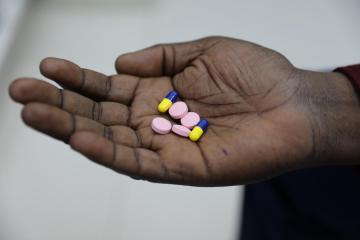
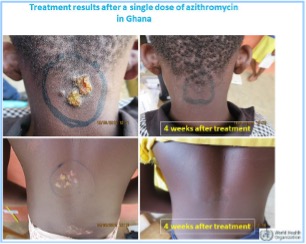
 Yaws can be cured by Azithromycin or benzathine penicillin:
Key facts
- Yaws is a chronic disfiguring and debilitating childhood infectious disease.
- Yaws affects skin, bone and cartilage
- Yaws is currently endemic in 9 African countries
- 50 -80% of the people affected are under 15 years of age
- Peak occurrence is in children aged 6 – 10 years
- A single dose of the antibiotic azithromycin can completely cure Yaws
- Yaws is targeted for eradication by 2030
- Mass treatment campaigns (also called total community treatment, TCT) and Total Targeted Treatment (TTT) are underway in affected populations
Yaws is caused by the bacterium Treponema pallidum subspecies pertenue, which is closely related genetically to T. pallidum subspecies pallidum, the causative agent of syphilis, bejel and pinta.
Humans are currently believed to be the only reservoir. Transmission is from person to person.
In the past, the disease was diagnosed through laboratory-based serological tests, but these tests cannot distinguish Yaws from syphilis. This means that careful clinical assessment of test results in Yaws-endemic areas is vital.
Currently, some rapid point-of-care tests syphilis Rapid Diagnostic Test (RDT) and Dual Path Platform (DPP) for Yaws can be used in the field.
The RDT test is used to detect any syphilis infection in suspected persons with skin lesions, while DPP is used only in RDT-positive patients to confirm the diagnosis of Yaws.
The polymerase chain reaction (PCR) test can also be used to confirm the diagnosis of Yaws by detecting the organisms in the skin lesions, and to test for antimicrobial resistance.
There is no vaccine for Yaws. Health education and improvement in personal hygiene are essential components in reducing transmission of the disease. Contacts of Yaws patients should be treated.
Yaws is targeted for global eradication by 2030 according to the Road map for neglected tropical diseases 2021–2030 and the Framework for the integrated control, elimination and eradication of tropical and vector-borne diseases in the African Region 2022–2030.
Eradication requires certification that all countries are Yaws-free.
The eradication approach consists of mass treatment (also called total community treatment, TCT) in which oral azithromycin (30 mg/kg, maximum 2 g) is administered to the entire population (minimum 90% coverage) in areas known as Yaws endemic.
Three criteria for eradication of Yaws are:
- absence of new serologically confirmed indigenous cases for 3 consecutive years;
- absence of any case proven by PCR; and
- absence of evidence of transmission for 3 continuous years measured with sero-surveys among children aged 1–5 years.
Some progress have been made to clarify progressively the epidemiological situation of Yaws and implement the Yaws eradication interventions in African Region.
- Three (Cameroon, Central African Republic, and Congo) out nine known Yaws-endemic countries in the Africa region have been implementing total community treatment (TCT – treating the whole population) with azithromycin for Yaws eradication since 2020 after mapping. Target total treatment (TTT-treating clinical cases and contacts) has been implemented in the six other endemic countries with the support WHO, EMS,
- The strengthening of integrated surveillance systems, partnership and country ownership are being promoted in the 26 previously endemic countries. These countries are encouraged to integrated Yaws in the NTD master plan.
- Twelve countries with no history of Yaws (that are close to achieving NTDs road map targets) are encouraged and will be supported to prepare the dossier for review and certification of non-endemic status.
Organization of Coordination for the Control of Endemic Diseases in Central Africa, FAIRMED, Anesvad Foundation, Raoul Follereau Foundation and GLRA/DAHW
- Eradication of Yaws: surveillance, monitoring and evaluation. A manual for Yaws eradication programme managers
- Eradication of Yaws: a guide for programme managers
- Eradication of Yaws: procedures for verification and certification of interruption of transmission
- Report of the regional consultation on yaws eradication in Africa
- Yaws: Training of health workers at national and districts levels on skin-NTDs
- Training material to help health workers
- Yaws: recognition booklet for communities
- The Global Health Observatory (GHO): Yaws
- Framework for the integrated control, elimination and eradication of tropical and vector-borne diseases in the African Region 2022–2030: report of the Secretariat
- Ending disease in Africa: responding to communicable and noncommunicable diseases, progress report 2020-2022
- Ending disease in Africa: vision strategies and special initiatives, 2023-2030.
- Report of a WHO meeting on skin-related neglected tropical diseases in West Africa, Geneva, 3-5 October 2022
- Ending the neglect to attain the sustainable development goals: a road map for neglected tropical diseases 2021–2030.
- Ending the neglect to attain the sustainable development goals: a strategic framework for integrated control and management of skin-related neglected tropical diseases
- Other publications
The disease presents in three stages, the first and second of which can be treated. The third stage can involve changes to the bones in many parts of the body.
- Primary Yaws (1-3 months from infection) is characterized by ulcers and papillomas.
- In the secondary stage (3 months to 2 years of infection), symptoms include bone swelling and plantar keratosis.
- Tertiary Yaws (up to 10 years after infection) is marked by cartilage destruction and bone malformations.