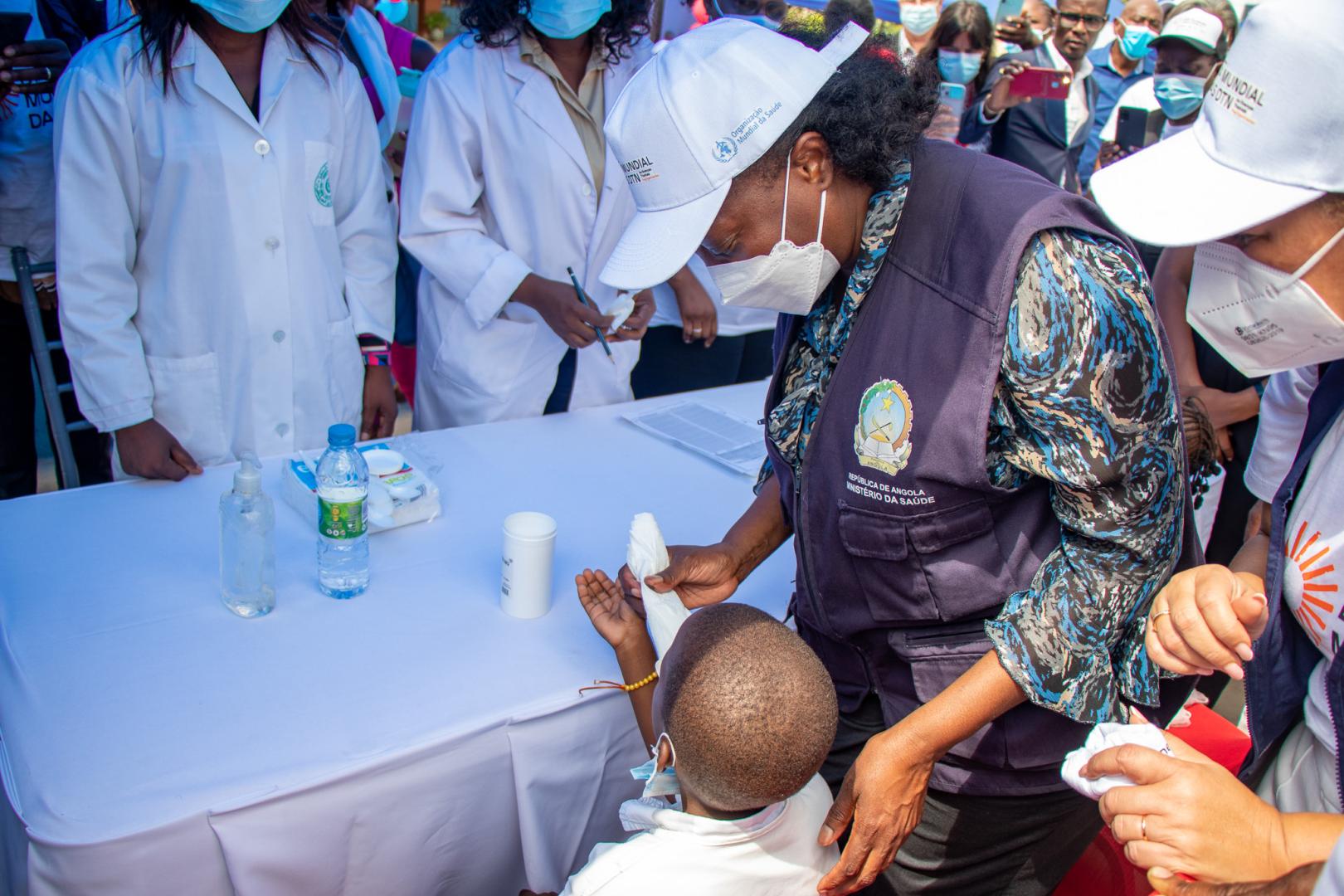
Protecting children to promote learning in Angola: Results of the National School Deworming Campaign
In Angola, schistosomiasis (SCH) and soil-transmitted helminthiasis (STH) remain significant public health challenges, affecting children's nutritional status, learning ability, and school performance, particularly in endemic regions.
In line with global health commitments and the 2030 Agenda, Angola has set a goal to eliminate schistosomiasis and soil-transmitted helminthiasis as public health problems by 2030. Deworming campaigns are a strategic, cost-effective, and sustained intervention to reduce the impact of these diseases, promoting the integral development of children and equity in access to health care.
Under Subcomponent 1.1-School Health of the Girl Empowerment and Learning for All Project (PAT II), the Ministries of Education and Health, with technical support from the World Health Organization (WHO) and partners, implemented two rounds of the National School Deworming Campaign.
The campaign ran from November 2024 to May-June 2025, covering 12 provinces, namely Benguela, Cabinda, Icolo e Bengo, Luanda, Huambo, Malanje, Lunda Norte, Lunda Sul, Namibe, Cunene, Moxico, Uíge, and Zaire. A total of 3,294,513 children and adolescents between the ages of 5 and 14 were dewormed, out of a target of 3,614,163, achieving 91% coverage in 5,281 schools. This result highlights the strong community support and operational effectiveness of the teams involved.
The success of the campaign was largely due to the adoption of a cascade training model, which began with Gender Focal Points and provincial teams, then progressed to municipal technicians and school principals. Communication and social mobilization actions were also implemented to address resistance, misinformation, and fears about the drugs. According to the Minister of Health, Dr. Silvia Lutucuta, “a key factor in the success of this campaign was the commitment and essential support of the Municipal Health and Education Directorates, the World Health Organization, community organizations, school principals, traditional authorities, and volunteers.”
The School Deworming Campaign demonstrates that it is possible to reach a large number of school-age children equitably by using schools as a health platform. This approach not only protects children's health, but also contributes to reducing school absenteeism, improving academic performance, and promoting quality learning.
The campaign demonstrated the government's and technical teams' ability to reach both urban and rural areas, overcome logistical challenges, and implement best practices on a large scale.
The results presentation ceremony, held on December 12, 2025, in Luanda, culminated in the Declaration of Commitment to the continuity of School Health actions, reaffirming the WHO's commitment to supporting the MOH in expanding good practices, modernizing information systems, and ensuring increasingly effective, equitable, and sustainable interventions.
“Ensuring healthy children means ensuring healthy families, resilient communities, and securing Angola's future,” said Dr. Indrajit Hazarika, WHO Representative in Angola.
Communication Assistant
WHO Angola
rpedro [at] who.int (rpedro[at]who[dot]int)