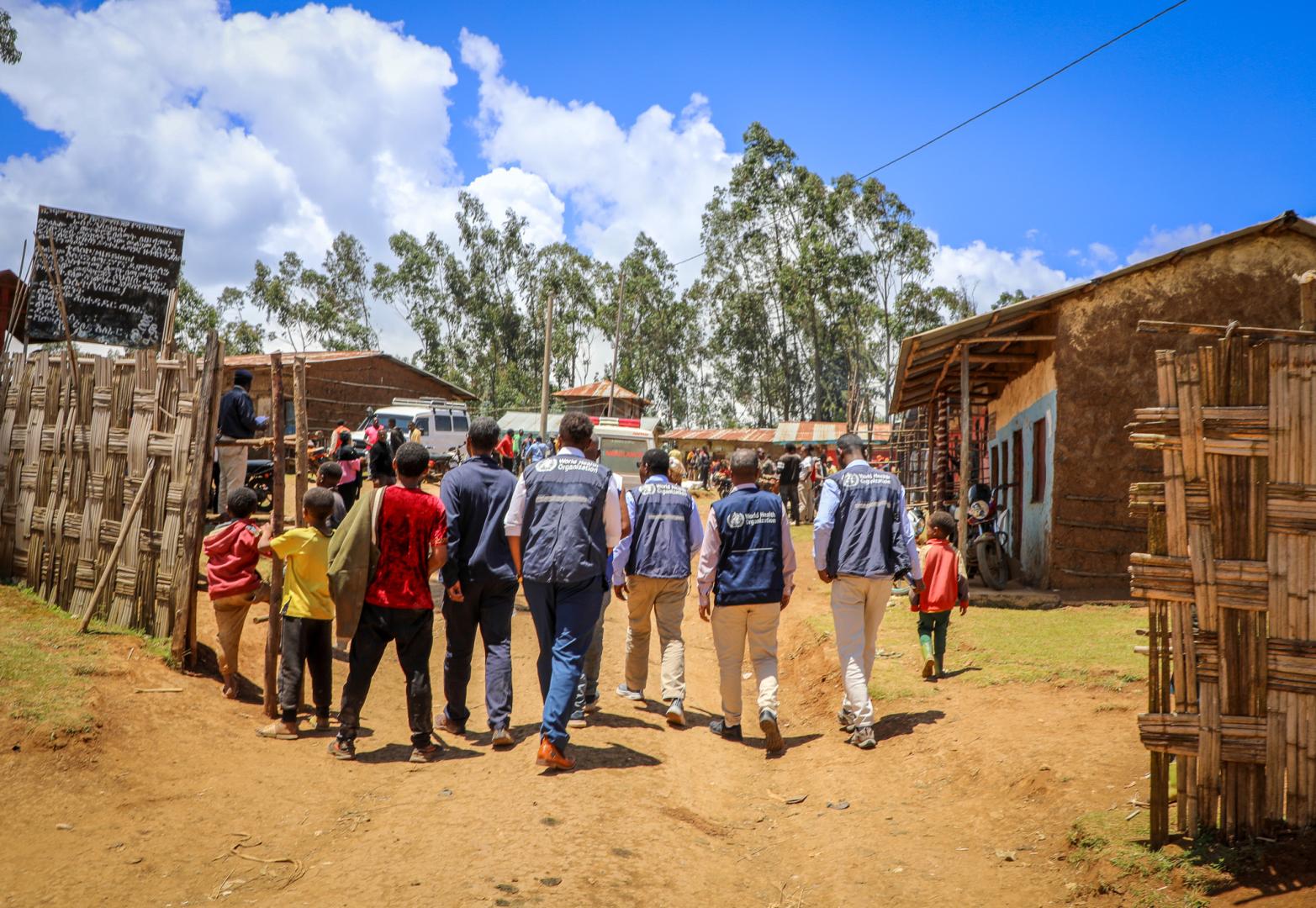
Ethiopia launches rapid health emergency response to recent landslides
Arba Minch, South Ethiopia Region—March 2026 will forever be etched in the memory of 40-year-old Datare Debebe Dasho. A resident of Genata Village in Gacho Baba Woreda (District) in South Ethiopia Region, Datare is a survivor of catastrophic landslides that occurred between 9 and 10 March.
Heavy and continuous rainfall triggered multiple landslides and flooding across eight woredas in Gamo Zone, South Ethiopia Region, leaving widespread destruction and loss of life. At least 125 deaths have been reported, with 81 bodies recovered so far.
"First I heard that one household with four family members were buried by the first landslide and we came to rescue the survivors,” she recalls. “The following day the second landslide from the other side came up on us and buried a lot of my neighbours. My right leg fractured but God saved my life, while dozens passed away."
According to Datare, hundreds of rescuers were also buried when the second landslide struck.
Over 18 000 people have been displaced, more than half of them from women-headed households and many are currently sheltering in churches and schools after almost 3000 homes were damaged or destroyed.
“A devastating event such as this requires a rapid response,” says Dr Thierno Balde, head of Emergency Preparedness and Response at World Health Organization (WHO) Ethiopia. “Homes, health facilities and community structures have been destroyed, leaving the door wide open for vector- and water-borne infectious diseases. It was important for response teams to immediately deploy to protect health and well-being and save lives.”
Emergency coordination mechanisms were activated soon after the disaster. A multisectoral Incident Management System and a Zonal Task Force are leading the response, bringing together health authorities and partners to address immediate needs and prevent secondary health risks among displaced communities.
Health workers have been deployed to temporary sites where displaced families have gathered. So far, 695 people have received treatment through mobile and temporary clinics, including 105 patients treated for injuries sustained during the landslides. The most reported conditions include soft tissue injuries, acute gastroenteritis, pneumonia, internal parasitic infections and scabies—illnesses often linked to overcrowding, poor sanitation and exposure to the elements.
"The other survivors dug me out and washed my body,” says Datare. Although she initially mistrusted medical care, after two days she allowed emergency health workers to clean her leg, tie the wound and refer her to Arba Minch General Hospital.
“They accepted me with great patience, treated me and provided soap, cloth, and medicines without any payment. Today I am ready to go to my home since my house is not damaged,” she says.
Health education has also been a key part of the response. Over 19 000 people have been reached with messages on hygiene and disease prevention to reduce the risk of outbreaks in crowded shelters.
Children have been prioritized for nutrition screening. Of the 34 650 children identified for screening, around 27 460 have already been assessed. Health workers identified 674 cases of moderate acute malnutrition and 263 cases of severe acute malnutrition, with all children linked to treatment programmes.
An emergency task team was established at WHO the country office from the first day of the crisis to coordinate support. The Organization deployed three rapid response teams comprising 21 multidisciplinary experts to the most affected woredas. Each team includes doctors, nurses and specialists in surveillance, water, sanitation and hygiene, and risk communication and community engagement. Logistics and vehicle support have been provided to ensure teams can reach remote communities.
According to Dr Agune Ashole, Director General of the South Ethiopia Region Public Health Institute, this early support was critical. “WHO was among the first to respond to the landslide emergency. Technical guidance, supplies and partner coordination were essential in reaching affected communities, continuing the strong support seen in previous emergencies, including the recent Marburg virus disease outbreak,” he says.
Additional rapid response staff are being deployed to Arba Minch to reinforce ongoing recovery operations and assist local health authorities.
WHO also supported the response through the provision of emergency medical supplies and technical expertise. The Organization has mobilized and handed over to the Regional Health Bureau supplies sufficient to treat up to 16 000 people. Additional trauma kits, Interagency Emergency Health Kits and paediatric severe acute malnutrition kits are being prepared for delivery.
“During the landslide, we relied on WHO-provided medicines and medical supplies to deliver life-saving interventions on time,” says Dr Nahom Tadelle, Emergency Medical Team Lead at the Ethiopian Public Health Institute. “Temporary clinics and rapid support allowed us to reach the hardest-hit communities.”
As recovery efforts continue, health authorities and partners remain focused on restoring access to essential health services, preventing disease outbreaks and ensuring that displaced families receive the care they need while recovery efforts are under way.
Communications Officer
WHO Ethiopia
Email: gebremichaela [at] who.int (gebremichaela[at]who[dot]int)