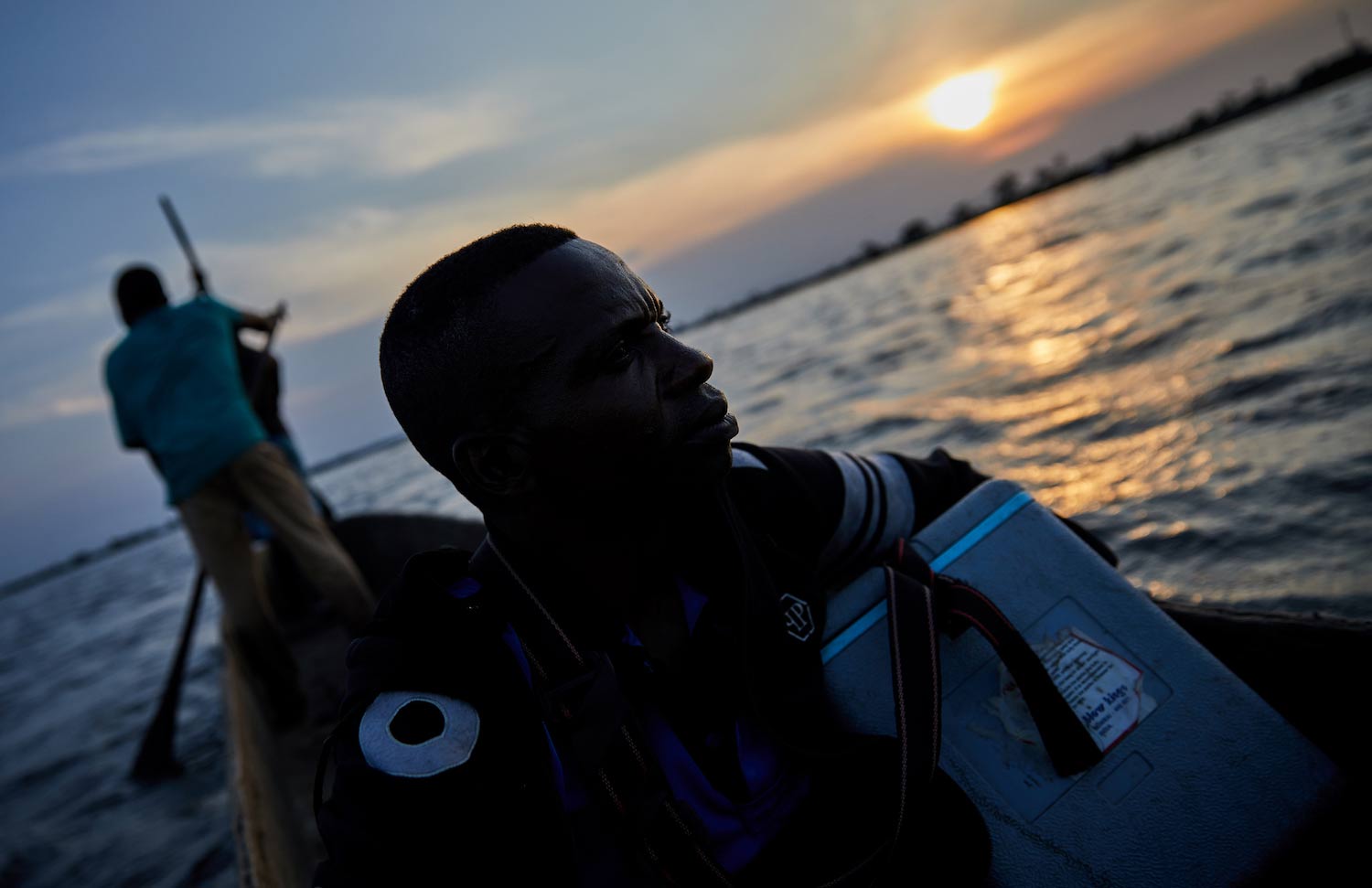
Polio response programme bolsters Ebola outbreak control
Kinshasa—The Democratic Republic of the Congo has declared the end of its latest Ebola outbreak, thanks in part to the trusted infrastructure and expertise of the national polio eradication programme.
In close collaboration with the Ministry of Health, World Health Organization (WHO) swiftly deployed a multidisciplinary team of seven polio experts to support disease surveillance, logistics, contact tracing and community engagement in the affected health zones in Kasai Province.
The WHO sub-office in Kasai (supported through polio funds) served as a key logistical hub, ensuring a rapid, coordinated response that helped bring the outbreak under control. Leveraging their experience from years of house-to-house vaccination drives, local polio staff helped map hard-to-reach settlements, track population movements and raise awareness about Ebola prevention measures. As Ebola vaccination got underway, the presence of trained polio staff on the ground helped to ensure that lifesaving messages and supplies reached every at-risk community.
Over recent years, the Democratic Republic of the Congo has made major strides in the fight against polio. Following the interruption of Wild poliovirus type 1 transmission in Africa in 2020, the country has continued to address circulating variant poliovirus type 1 and 2 (cVDPV1 and 2) through a series of nationwide and targeted immunization campaigns, reaching over 33 million children in 2025 alone (including children under 14 years in certain provinces).
Improved environmental surveillance, rapid case investigation and strengthened laboratory capacity are now cornerstones of the country’s polio strategy. The same assets were used for the Ebola response.
“We ensured our trained polio teams were rapidly deployed to Kasai to reinforce case investigation, contact tracing and data management,” said Dr Aïcha Diakité, WHO Polio Team Lead with a focus on capacity building in the Democratic Republic of the Congo. “Our logisticians supported the transport of samples to the national laboratory, disease surveillance officers trained local health workers, and our communication experts helped build trust in affected communities. The same systems that help us stop poliovirus were crucial in ending the latest Ebola outbreak, showing how polio investments continue to protect lives far beyond polio.”
The efficiency of the polio programme is evident: detections of variant poliovirus type 1 have dropped from 107 in 2023 to 10 in 2024 and just 01 so far in 2025, showing how the same systems driving polio success supported the Ebola response.
“Polio teams are deeply rooted in communities as they know the terrain, the people, and how to move fast,” said Dr Lusamba Kabamba, Global Polio Eradication Initiative coordinator in the Democratic Republic of the Congo. “Their support is accelerating efforts to contain the virus and protect lives.”
Specifically, teams were quickly instructed to support surveillance and Active Case Finding, Risk Communication; and to use the expertise of Polio teams in micro-planning for the rapid deployment of resources.
This integrated approach builds on the polio programme’s broader legacy of supporting responses to other health emergencies in the region, from cholera to mpox.
Communications Officer
Polio Eradication Programme
WHO Regional Office for Africa
Email: mongem [at] who.int (mongem[at]who[dot]int)
Tel: + 34 636 04 76 79
Communications Officer
WHO DRC
Tel : +243 81 715 1697
Office : +47 241 39 027
Email: kabambie [at] who.int (kabambie[at]who[dot]int)