Governança
O Comité Regional para África da OMS é o órgão decisório da Organização sobre política de saúde na Região Africana. É composto pelos Ministros da Saúde ou seus representantes de cada um dos 47 Estados Membros da Região. As principais funções do Comité Regional incluem a formulação de políticas regionais e a supervisão do gabinete regional, tal como estabelecido no artigo 50º da Constituição da OMS. O Comité também nomeia o Director Regional para África de cinco em cinco anos e transmite a sua decisão ao Conselho Executivo da OMS para endosso. O Comité Regional reúne geralmente todos os anos em Agosto e o Director Regional actua como seu Secretário.
O Comité Regional é orientado nos seus trabalhos pelo seu Regulamento Interno e pela Constituição da OMS.
Documentos úteis
- Regulamento Interno do Comité Regional para África
- Constituição da OMS - Inglês
- Acreditação de actores regionais não estatais que não mantêm relações oficiais com a OMS para que possam participar no Comité Regional da OMS para a África
- Comité Regional para África da OMS: Guia para os Estados Membros e participantes
Septuagésima quinta sessão do Comité Regional da Organização Mundial da Saúde para a África
A septuagésima quinta sessão do Comité Regional da Organização Mundial da Saúde para a África realizar-se-á em Lusaca (Zâmbia), de 25 a 27 de Agosto de 2025. O Comité Regional é o órgão de decisão da OMS na Região que se reúne uma vez por ano para discutir e aprovar políticas, actividades e planos financeiros destinados a melhorar a saúde das populações africanas.”
The World Health Assembly (WHA) is the supreme decision-making body for WHO. (See Articles 10-23 of WHO Constitution). It meets in Geneva, in May, and all 194 WHO Member States participate. The WHA appoints the Director-General, approves the biennial programme budget, considers reports and approves resolutions, put forward by the Executive Board.
The Executive Board (EB) is composed of 34 Members (7 members from the African region), technically qualified in the field of health, who are elected by the WHA, and serve for a three-year term. (See Articles 24-29 of the WHO Constitution). The EB meets twice a year. In January, the EB approves the provisional agenda for the WHA, reviews reports and approves draft resolutions to be considered by the WHA.
The Programme, Budget and Administration Committee (PBAC) is composed of twelve EB members (two from each region), along with the Chair of the EB, and one Vice-Chair. The term of membership is two years. The PBAC meets just before the January EB meeting, and immediately prior to the WHA.
For more information on the global governing bodies, kindly visit the following link.
O Subcomité do Programa (PSC) é um órgão subsidiário do Comité Regional. Foi criado para assistir o Comité Regional na revisão do Orçamento-Programa, nas estratégias regionais, nos relatórios técnicos e nas resoluções propostas e para aconselhar sobre questões políticas e de governação.
O Subcomité do Programa é composto por dezoito representantes dos Estados-Membros. De acordo com os termos de referência do Subcomité do Programa (insert the hyperlink to download the ToRs), três membros do Conselho Executivo da Região Africana e o Coordenador do Grupo Africano com sede em Genebra também participam nas reuniões do Subcomité na qualidade de observadores.
Descarregar novo mandato do Subcomité do Programa do Comité Regional da OMS para a África [PDF]
Programme Subcommittee Members
Sub-região 1
-
Gâmbia (2019–2022)
- Guiné (2019–2022)
- Libéria (2020–2023)
- Mali (2020–2023)
- Mauritânia (2021– 2024)
- Níger (2021–2024)
Sub-região 2
- Congo (2019–2022)
- República Democrática do Congo (2019–2022)
- República Centro-Africana (2020–2023)
- Eritreia (2020–2023)
- Sudão do Sul (2021–2024)
- Uganda (2021–2024)
Sub-região 3
- Maláui (2019–2022)
- Maurícia (2019–2022)
- Moçambique (2020– 2023)
- Namíbia (2020–2023)
- Seicheles (2021–2024)
- África do Sul (2021– 2024)
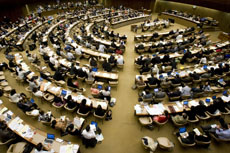
The World Health Assembly is the highest decision-making body of WHO. It is attended by delegations from all WHO Member States and focuses on a specific health agenda prepared by the Executive Board.The main functions of the World Health Assembly are to determine the policies of the Organization, appoint the Director-General, supervise financial policies, and review and approve the proposed programme budget. The Health Assembly is held annually in Geneva, Switzerland.
Next Health Assembly
- Seventieth World Health Assembly » (22-31 May 2017)
The evolution of WHO’s work and the increasing number of entities associated with global health has necessitated changes in the way WHO is governed, and the way WHO engages with external stakeholders. In this regard, WHO’s governance reform aims to strengthen both the internal governance of WHO by Member States, as well as the role of WHO in global health governance.
GOVERNANCE REFORMThe proposals for change in respect of internal governance focus on improving the work of the governing bodies – the World Health Assembly, the Executive Board and the Regional Committees – including strengthening global-regional linkages. The fundamental objectives for the internal governance reforms are to foster a more strategic and disciplined approach to priority setting, to enhance the oversight of the programmatic and financial aspects of the Organization, and to improve the efficiency and inclusivity of intergovernmental consensus-building.
In relation to WHO’s engagement with external stakeholders, WHO is exploring ways to more effectively collaborate with relevant stakeholders including nongovernmental organizations, partnerships, the private sector, foundations, and other relevant stakeholders with a view to promoting greater coherence in global health. The challenge here is to determine how WHO can engage with a wider range of players without undermining its intergovernmental nature or opening itself to influence by those with vested interests. Moreover, governance reforms aim to strengthen the multilateral role of WHO and to capitalize more effectively on WHO’s leadership position in global health.